

My Store
Custom High-Voltage Vacuum Feedthroughs for UHV
Custom High-Voltage Vacuum Feedthroughs for UHV
Couldn't load pickup availability
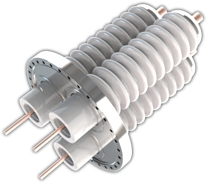
High-voltage vacuum feedthroughs provide hermetic electrical interfaces for transmitting kV-level DC or pulsed voltage across HV/UHV vacuum boundaries.
They are engineered for applications requiring high dielectric strength, stable insulation, and long-term reliability, including accelerators, vacuum instrumentation, and high-voltage research systems.
- Voltage range: kV-level (application dependent)
- Signal type: DC or pulsed high voltage
- Vacuum rating: HV / UHV compatible
- Insulation: ceramic-to-metal hermetic seal
- Polarity: positive or negative HV
- Operation: continuous or pulsed
What This Product Demonstrates
This page presents representative high-voltage vacuum feedthrough designs. Final assemblies are custom-engineered based on voltage level, insulation distance, flange standard, and vacuum environment.
Typical Applications
- Particle accelerators and beamline components
- Electrostatic lenses and deflectors
- High-voltage electrodes in vacuum
- Vacuum power supplies and test systems
- Scientific and industrial HV vacuum equipment
What Is a High-Voltage Vacuum Feedthrough?
A high-voltage vacuum feedthrough enables electrical power to pass from atmosphere into a vacuum chamber while maintaining electrical insulation and vacuum integrity.
The design relies on a ceramic-to-metal hermetic seal that provides both dielectric isolation and mechanical strength under high electric fields.
Key Design Considerations
- Electric field distribution and creepage distance
- Dielectric strength of ceramic insulator
- Surface flashover prevention
- Thermal and mechanical stress during bakeout
- Long-term stability under high voltage
Customization Options
- Maximum operating voltage (kV level)
- DC or pulsed voltage operation
- Single-pin or multi-electrode designs
- Flange type (CF / KF / custom)
- Ceramic length and diameter
- Grounding and shielding configuration
Engineering Specification Checklist
- Target voltage level (kV)
- DC or pulsed operation
- Vacuum level (HV / UHV)
- Bakeout temperature requirement
- Flange type and mechanical constraints
- Polarity and insulation clearance
- Environmental and safety requirements
Related Feedthrough Solutions
- Accelerator & BPM Feedthroughs
- RF & Microwave Vacuum Feedthroughs
- High-Current Vacuum Feedthroughs
- Custom & Hybrid Feedthroughs
FAQ
What voltage range can a high-voltage vacuum feedthrough support?
High-voltage vacuum feedthroughs can be designed for kV-level operation. The exact rating depends on ceramic geometry, insulation distance, and vacuum conditions.
Can high-voltage feedthroughs be used in UHV systems?
Yes. Properly designed ceramic-to-metal sealed feedthroughs are compatible with UHV environments and high-temperature bakeout.
Are these feedthroughs suitable for pulsed high voltage?
Yes. Designs can support both continuous DC and pulsed high-voltage operation, depending on application requirements.
Share