

My Store
Custom Hybrid Vacuum Feedthroughs for RF & HV Signals
Custom Hybrid Vacuum Feedthroughs for RF & HV Signals
Couldn't load pickup availability
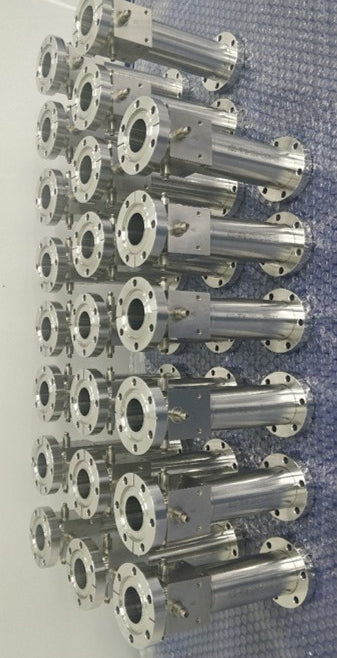
Custom & hybrid vacuum feedthroughs integrate multiple electrical interfaces—such as RF, high voltage, high current, and signal lines—into a single hermetic vacuum assembly.
They are designed for space-constrained, system-level integrations where standard single-function feedthroughs are insufficient, especially in accelerators, beamlines, and advanced research vacuum systems.
- Interface types: RF / microwave, high voltage, high current, signal
- Integration: multiple functions on one flange
- Vacuum rating: HV / UHV compatible
- Design focus: isolation, grounding, thermal management
- Production: prototype to small-batch manufacturing
What This Product Demonstrates
This page presents representative custom and hybrid feedthrough concepts. Each assembly is engineered case-by-case based on electrical, mechanical, thermal, and vacuum constraints.
Typical Applications
- Accelerator beamline upgrades and retrofits
- Integrated diagnostics ports (RF + signal + bias)
- Electron and ion source assemblies
- Space-limited experimental vacuum chambers
- Prototype and one-off research systems
What Is a Custom & Hybrid Vacuum Feedthrough?
A custom or hybrid vacuum feedthrough combines multiple electrical functions within a single vacuum flange while maintaining hermeticity, electrical isolation, and long-term reliability.
Unlike standard feedthroughs, hybrid designs must address cross-interference, grounding strategy, thermal coupling, and mechanical integration simultaneously.
Common Hybrid Combinations
- RF + signal (diagnostics and monitoring)
- High voltage + signal (bias and control)
- High current + signal (heaters and sensors)
- RF + high voltage (accelerator subsystems)
- RF + power + signal (fully integrated ports)
Key Design Challenges
- Electrical isolation between dissimilar interfaces
- Grounding and shielding strategy
- Thermal coupling between high-current and sensitive signals
- Vacuum bakeout compatibility
- Mechanical tolerances and port density
Customization Options
- Interface type and channel count
- Voltage and current rating per channel
- RF connector standard and frequency range
- Flange size, layout, and bolt pattern
- Internal routing, shielding, and grounding
- Prototype vs small-series production
Engineering Specification Checklist
- Electrical interfaces required (RF / HV / current / signal)
- Voltage and current per interface
- RF frequency range and performance targets
- Vacuum level (HV / UHV) and bakeout temperature
- Available flange size and mechanical constraints
- System drawings or integration notes (if available)
Related Feedthrough Products
- RF & Microwave Vacuum Feedthroughs
- High-Voltage Vacuum Feedthroughs
- High-Current Vacuum Feedthroughs
- Multi-Pin & Signal Feedthroughs
FAQ
What is a hybrid vacuum feedthrough?
A hybrid vacuum feedthrough integrates multiple electrical functions—such as RF, high voltage, high current, and signal—into a single hermetic vacuum assembly.
Why use a hybrid feedthrough instead of multiple separate feedthroughs?
Hybrid feedthroughs reduce port count, save space, simplify integration, and improve system reliability in compact or complex vacuum systems.
Can hybrid feedthroughs be designed for UHV and bakeout?
Yes. With appropriate material selection and sealing methods, hybrid feedthroughs can meet UHV and high-temperature bakeout requirements.
Are custom hybrid feedthroughs suitable for small quantities?
Yes. They are commonly produced as one-off prototypes or small-batch assemblies for research and accelerator applications.
Share