
My Store
Custom High-Current Vacuum Feedthroughs for UHV Power
Custom High-Current Vacuum Feedthroughs for UHV Power
Couldn't load pickup availability
High-current vacuum feedthroughs provide hermetic electrical interfaces for transmitting high-amperage power across HV/UHV vacuum boundaries.
They are engineered for applications requiring stable current delivery, low contact resistance, and thermal reliability, such as heaters, filaments, magnets, and high-power experimental systems.
- Current range: tens to hundreds of amperes (application dependent)
- Signal type: DC or low-frequency power
- Vacuum rating: HV / UHV compatible
- Conductor: solid metal pin or high-current rod
- Thermal design: optimized for continuous operation
- Mounting: CF / KF / custom flange
What This Product Demonstrates
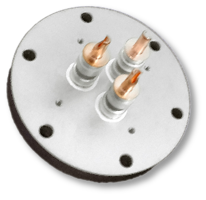
This page shows representative high-current vacuum feedthrough designs. Final products are custom-engineered based on current level, duty cycle, thermal constraints, and mechanical integration.
Typical Applications
- Vacuum heaters and heating stages
- Filament and cathode power feeds
- Electromagnets and solenoids
- Vacuum furnaces and thermal processing systems
- High-current laboratory test chambers
What Is a High-Current Vacuum Feedthrough?
A high-current vacuum feedthrough allows electrical power to pass from atmosphere into a vacuum chamber while maintaining vacuum integrity and electrical isolation.
Unlike signal feedthroughs, high-current designs focus on conductor cross-section, contact resistance, and heat dissipation to ensure stable operation under continuous load.
Key Design Considerations
- Maximum continuous and peak current
- Conductor material and cross-sectional area
- Thermal rise and heat dissipation
- Contact resistance and mechanical stability
- Compatibility with vacuum bakeout
Customization Options
- Maximum current rating (A)
- Continuous vs pulsed operation
- Single-pin or multi-conductor layouts
- Flange type and size
- Conductor length and termination style
- Thermal management considerations
Engineering Specification Checklist
- Target current (A) and duty cycle
- Operating voltage (if applicable)
- Vacuum level (HV / UHV)
- Bakeout temperature requirement
- Flange standard and mechanical constraints
- Termination type (stud, lug, cable, custom)
Related Feedthrough Solutions
- Accelerator & BPM Feedthroughs
- RF & Microwave Vacuum Feedthroughs
- High-Voltage Vacuum Feedthroughs
- Custom & Hybrid Feedthroughs
FAQ
What current levels can high-current vacuum feedthroughs support?
High-current vacuum feedthroughs can be designed for tens to hundreds of amperes, depending on conductor size, thermal design, and duty cycle.
Can high-current feedthroughs operate continuously?
Yes. Designs can support continuous current operation when thermal rise, contact resistance, and cooling constraints are properly addressed.
Are high-current feedthroughs compatible with UHV and bakeout?
Yes. With suitable materials and sealing methods, high-current feedthroughs can be designed for UHV environments and high-temperature bakeout.
Share