

My Store
Custom RF & Microwave Vacuum Feedthroughs
Custom RF & Microwave Vacuum Feedthroughs
Couldn't load pickup availability
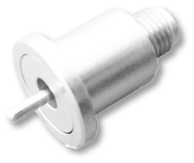
RF & microwave vacuum feedthroughs provide hermetic coaxial signal interfaces for transmitting high-frequency electrical signals across HV/UHV vacuum boundaries.
They are designed for applications where impedance control, low insertion loss, and vacuum integrity are critical, including accelerators, RF diagnostics, and research vacuum systems.
- Signal type: RF & microwave coaxial
- Frequency range: DC to GHz (application-dependent)
- Vacuum rating: HV / UHV compatible
- Connector options: SMA, 2.92 mm (K), N-type, BNC
- Sealing: Ceramic-to-metal hermetic seal
- Operation: CW or pulsed RF
What This Product Demonstrates
This page presents representative RF & microwave vacuum feedthrough designs. Final assemblies are custom-engineered based on frequency band, power level, flange standard, connector type, and vacuum requirements.
Typical Applications
- RF cavities and couplers
- Beam diagnostics and RF pickup systems
- Microwave diagnostics in accelerators
- Vacuum RF test stands
- Laboratory high-frequency instrumentation
Key Design Considerations
- Controlled impedance through ceramic-metal transition
- Low insertion loss and stable VSWR
- Thermal and mechanical stability during bakeout
- Grounding and shielding continuity
- Long-term reliability under vacuum cycling
Engineering Specification Checklist
- Target frequency range
- Insertion loss / VSWR requirement
- RF power level (CW or pulsed)
- Connector standard and channel count
- Vacuum level (HV / UHV)
- Bakeout temperature
- Flange type and mechanical constraints
Related Feedthrough Solutions
- Accelerator & BPM Feedthroughs
- High-Voltage Vacuum Feedthroughs
- High-Current Vacuum Feedthroughs
- Custom & Hybrid Feedthroughs
FAQ
Which RF connector should I choose?
Connector selection depends on frequency range and power level. SMA and 2.92 mm connectors are commonly used for higher-frequency applications, while N-type and BNC are suitable for lower-frequency diagnostics.
Are RF vacuum feedthroughs suitable for UHV systems?
Yes. Designs can support UHV environments with ceramic-to-metal hermetic sealing and bakeout-compatible materials.
What is the difference between an RF feedthrough and a microwave window?
RF feedthroughs are typically used for signal transmission and diagnostics with controlled impedance, while microwave windows are designed for high-power RF injection.
Share