
My Store
SrTiO3 Single-Crystal Substrates for Epitaxy
SrTiO3 Single-Crystal Substrates for Epitaxy
Couldn't load pickup availability
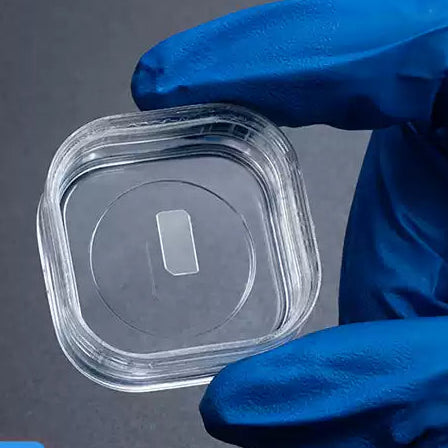
SrTiO₃ (Strontium Titanate) single crystal is a high-quality perovskite oxide material extensively used as a substrate for epitaxial growth of complex oxide thin films. Owing to its well-defined cubic perovskite structure, excellent lattice matching, and atomically smooth surface, SrTiO₃ is a benchmark substrate in superconductivity, ferroelectricity, multiferroics, dielectric materials, and oxide electronics research.
SrTiO₃ offers a high dielectric constant, good thermal stability, and excellent chemical compatibility with a wide range of oxide materials. These properties make it ideal for advanced thin-film deposition techniques such as PLD (Pulsed Laser Deposition), MBE, sputtering, and ALD, where precise lattice matching and surface quality are critical for achieving high-performance epitaxial layers.
Our SrTiO₃ single crystal substrates are manufactured with strict control of crystallographic orientation, thickness uniformity, and surface flatness. Precision polishing ensures low surface roughness suitable for atomic-scale film growth, enabling reproducible and reliable results for both fundamental research and device prototyping.
Multiple orientations and custom sizes are available to support diverse experimental requirements, including large-area substrates with diameters up to 35 mm. Custom specifications, including thickness, orientation, and surface finish, can be provided upon request.
Key Features & Properties
- Crystal Structure: Cubic perovskite
- Excellent lattice matching for complex oxides
- High dielectric constant
- Superior surface flatness and low roughness
- Compatible with PLD, MBE, sputtering, and ALD
- Available in multiple crystallographic orientations
- Custom sizes up to 35 mm diameter
Typical Applications
- Epitaxial growth of complex oxide thin films
- High-temperature superconductors
- Ferroelectric and multiferroic materials
- Dielectric and capacitor research
- Oxide electronics and spintronics
- Photonic and optoelectronic devices
For additional specifications, custom dimensions, or volume inquiries, please contact us for detailed technical support.
Frequently Asked Questions — SrTiO₃ Single Crystal
What is SrTiO₃ single crystal used for?
Why is SrTiO₃ a popular substrate for oxide epitaxy?
Which thin-film deposition techniques are compatible?
What crystallographic orientations are available?
What surface quality can be achieved?
What sizes and thicknesses are available?
Are these substrates suitable for research and device development?
📘 Related Knowledge
Share